_edited.jpg)

Why Mental Health Stigma Still Exists in 2026 and What It Is Really Costing Us
Updated: Apr 21
We Talk More About Mental Health Than Ever So Why Are People Still Silent
There has never been a time where mental health is talked about this openly. It is in social media posts, podcasts, workplace discussions, and even casual conversations. People say things like take care of your mental health and therapy is normal. On the surface, it looks like progress.

But behind closed doors, something very different is still happening.
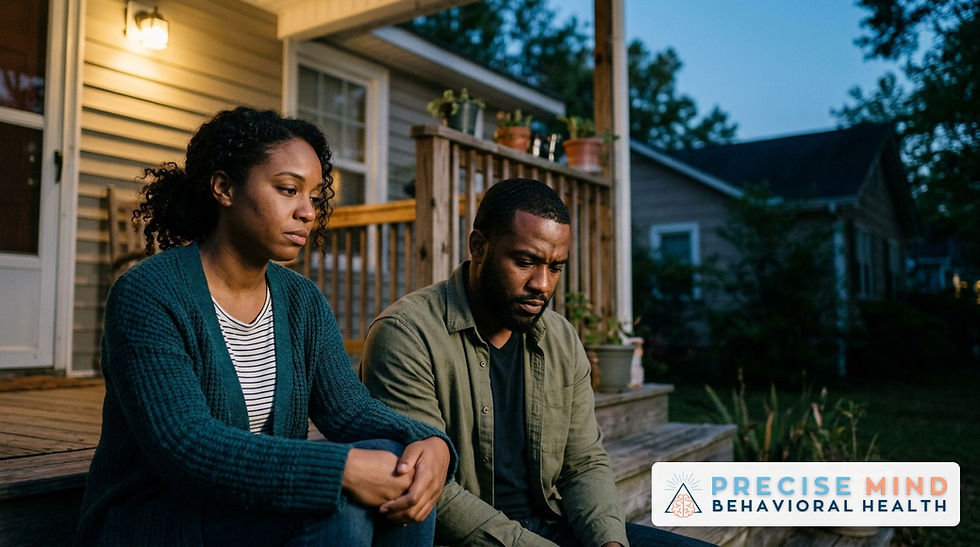
People are struggling quietly. They are canceling appointments before they even make them. They are convincing themselves they are fine when they are clearly not.
The truth is simple and uncomfortable. Awareness has increased, but stigma has not disappeared. It has just become quieter and more internal.
The Stigma Did Not Disappear It Adapted
Years ago, stigma was loud and obvious. People were labeled or dismissed openly. Today, stigma looks different. It is more subtle, which makes it harder to challenge.
Now it sounds like: “I should be able to handle this on my own.” “It is not serious enough to get help.” “I do not want people to look at me differently.”
These thoughts are not random. They are learned beliefs shaped by culture, upbringing, and personal experience. Over time, they become internal rules that people rarely question.
From a cognitive behavioral perspective, these are distorted thoughts. They feel true, but they are not grounded in evidence. They are based on fear, assumption, and social conditioning.
Why People Still Avoid Getting Help
Avoidance is one of the strongest psychological patterns we have. It offers immediate relief, which makes it powerful.
When someone avoids therapy, they feel temporary comfort. They do not have to talk about difficult things. They do not have to face uncomfortable emotions. That relief reinforces the behavior.
But over time, avoidance becomes a trap.
Anxiety grows stronger because it is never challenged.Depression deepens because isolation increases.Stress builds because there is no release or processing.
What feels like protection is actually prolonging the problem.
The Cost of Staying Silent
Mental health struggles do not stay contained in one area of life. They spread.
They show up in relationships as distance or conflict.They show up at work as burnout or lack of focus.They show up physically as fatigue, tension, and poor sleep.
People often wait until things reach a breaking point before seeking help. By then, the situation feels overwhelming and harder to manage.
Early support changes everything.
Changing the Narrative Around Therapy
One of the biggest barriers is how therapy is perceived. Many still see it as something you turn to only when things fall apart.
That view is outdated and harmful.
Therapy is not a last option. It is a tool for understanding, growth, and stability. It helps people recognize patterns, build emotional skills, and respond differently to stress.
It is not about being broken. It is about becoming more aware and more capable.
How We Actually Break Stigma
Real change does not come from slogans. It comes from behavior and consistency.
It starts with normalizing action. Talking about mental health is important, but acting on it is what creates change.
It involves challenging internal beliefs. When a thought says you should handle everything alone, pause and question it. Where did that belief come from and is it actually helping you.
It also requires visible examples. When people see others seeking help and benefiting from it, it reduces fear and uncertainty.
The Role of Supportive Care
Access to compassionate and evidence based care plays a major role in breaking stigma. When people feel understood and not judged, they are more willing to open up and continue the process.
Precise Mind Behavioral Health focuses on creating that kind of environment. The goal is not just to treat symptoms, but to help individuals understand themselves and build lasting skills.
Final Thought
Stigma does not survive because people do not care. It survives because people are afraid.
Fear of judgment. Fear of vulnerability. Fear of change.
But every time someone chooses to speak honestly, to seek support, or to challenge an old belief, that fear loses power.
Breaking stigma is not a single moment. It is a series of decisions made every day by people who decide they are no longer willing to struggle in silence.
-Crystal


Comments